| Article ID | Journal | Published Year | Pages | File Type |
|---|---|---|---|---|
| 3477067 | Journal of the Chinese Medical Association | 2010 | 6 Pages |
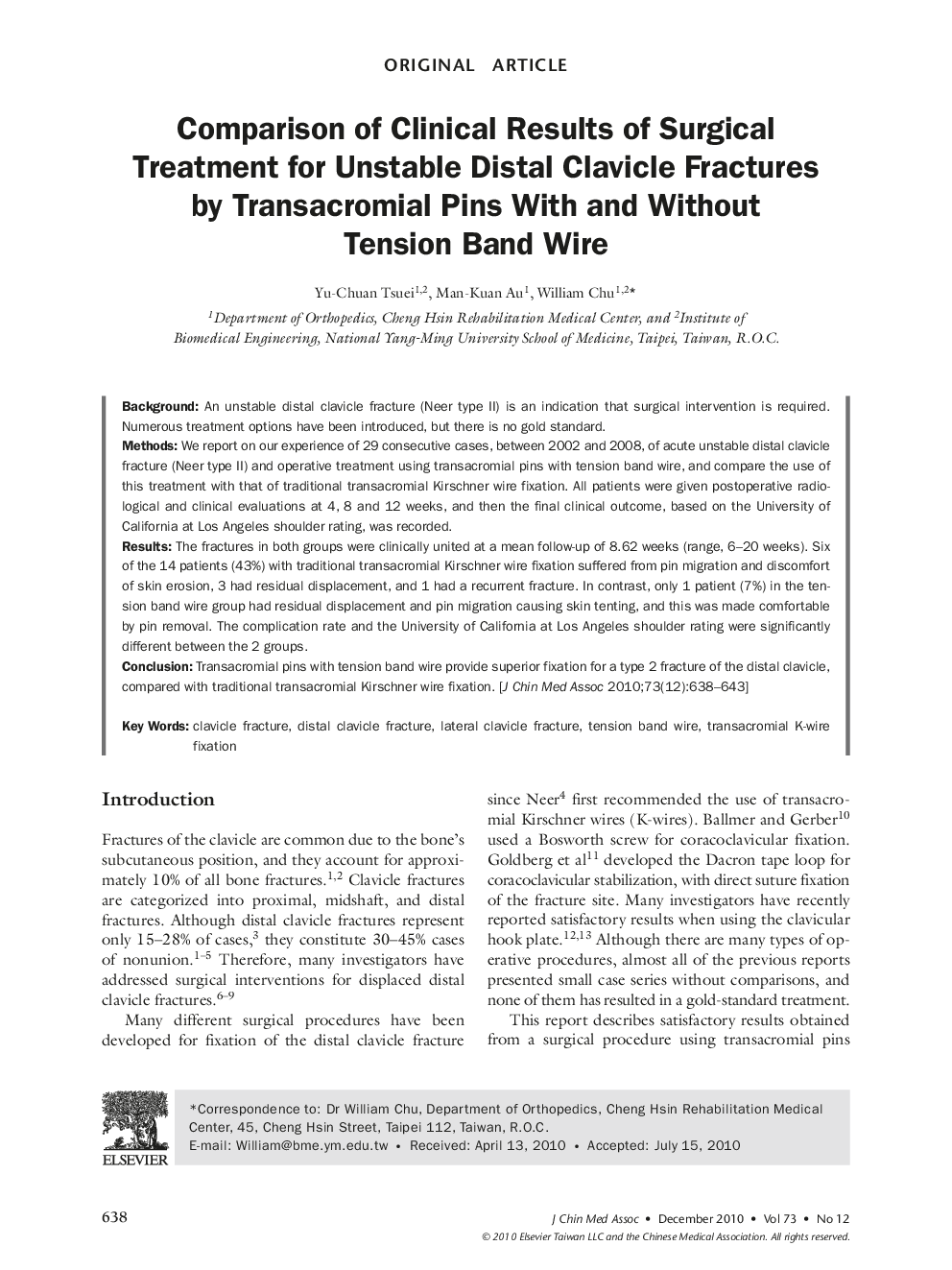
BackgroundAn unstable distal clavicle fracture (Neer type II) is an indication that surgical intervention is required. Numerous treatment options have been introduced, but there is no gold standard.MethodsWe report on our experience of 29 consecutive cases, between 2002 and 2008, of acute unstable distal clavicle fracture (Neer type II) and operative treatment using transacromial pins with tension band wire, and compare the use of this treatment with that of traditional transacromial Kirschner wire fixation. All patients were given postoperative radiological and clinical evaluations at 4, 8 and 12 weeks, and then the final clinical outcome, based on the University of California at Los Angeles shoulder rating, was recorded.ResultsThe fractures in both groups were clinically united at a mean follow-up of 8.62 weeks (range, 6-20 weeks). Six of the 14 patients (43%) with traditional transacromial Kirschner wire fixation suffered from pin migration and discomfort of skin erosion, 3 had residual displacement, and 1 had a recurrent fracture. In contrast, only 1 patient (7%) in the tension band wire group had residual displacement and pin migration causing skin tenting, and this was made comfortable by pin removal. The complication rate and the University of California at Los Angeles shoulder rating were significantly different between the 2 groups.ConclusionTransacromial pins with tension band wire provide superior fixation for a type 2 fracture of the distal clavicle, compared with traditional transacromial Kirschner wire fixation.