| Article ID | Journal | Published Year | Pages | File Type |
|---|---|---|---|---|
| 717163 | IFAC Proceedings Volumes | 2012 | 6 Pages |
Abstract
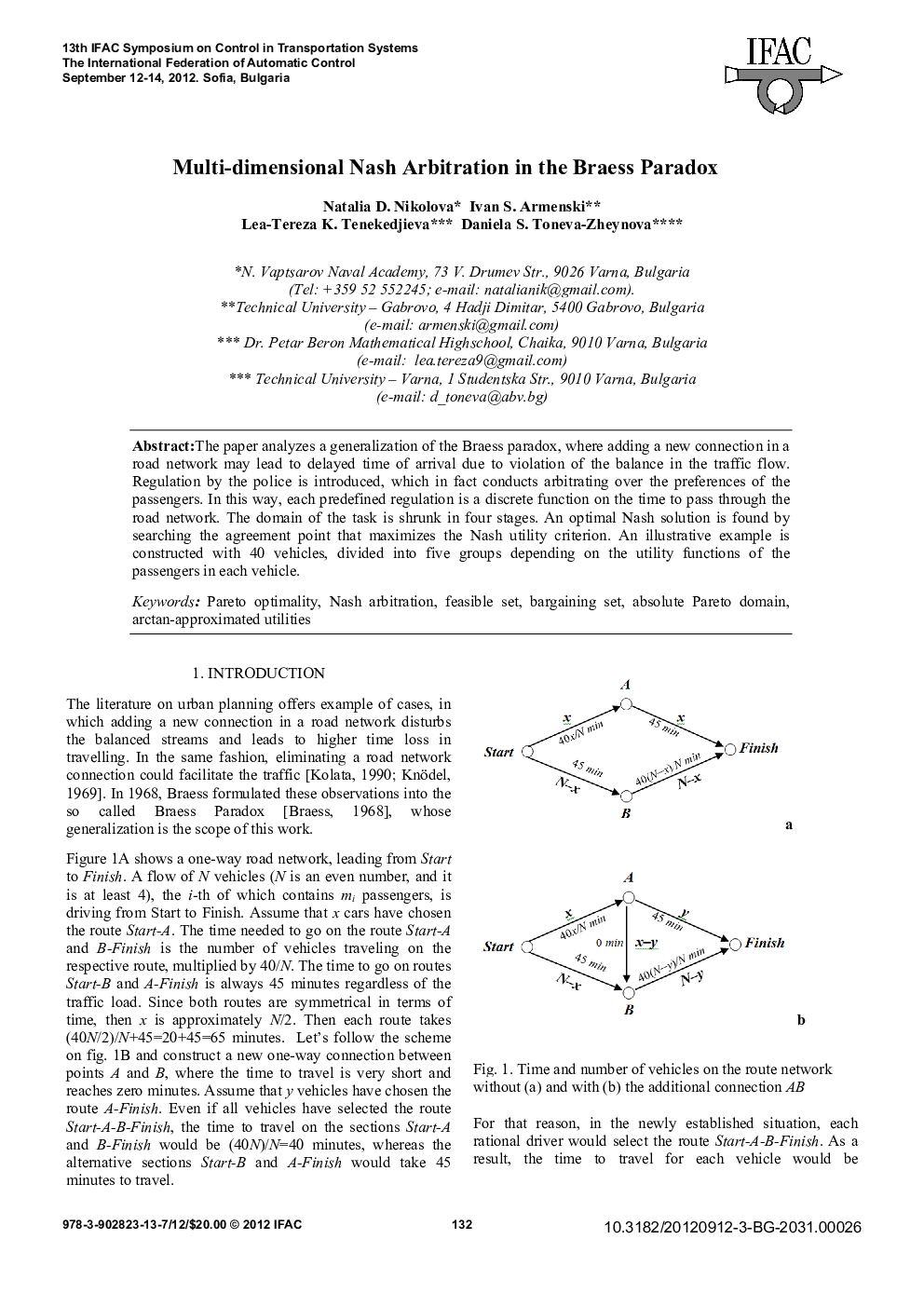
The paper analyzes a generalization of the Braess paradox, where adding a new connection in a road network may lead to delayed time of arrival due to violation of the balance in the traffic flow. Regulation by the police is introduced, which in fact conducts arbitrating over the preferences of the passengers. In this way, each predefined regulation is a discrete function on the time to pass through the road network. The domain of the task is shrunk in four stages. An optimal Nash solution is found by searching the agreement point that maximizes the Nash utility criterion. An illustrative example is constructed with 40 vehicles, divided into five groups depending on the utility functions of the passengers in each vehicle.
Related Topics
Physical Sciences and Engineering
Engineering
Computational Mechanics