| کد مقاله | کد نشریه | سال انتشار | مقاله انگلیسی | نسخه تمام متن |
|---|---|---|---|---|
| 679047 | 1459929 | 2016 | 8 صفحه PDF | دانلود رایگان |
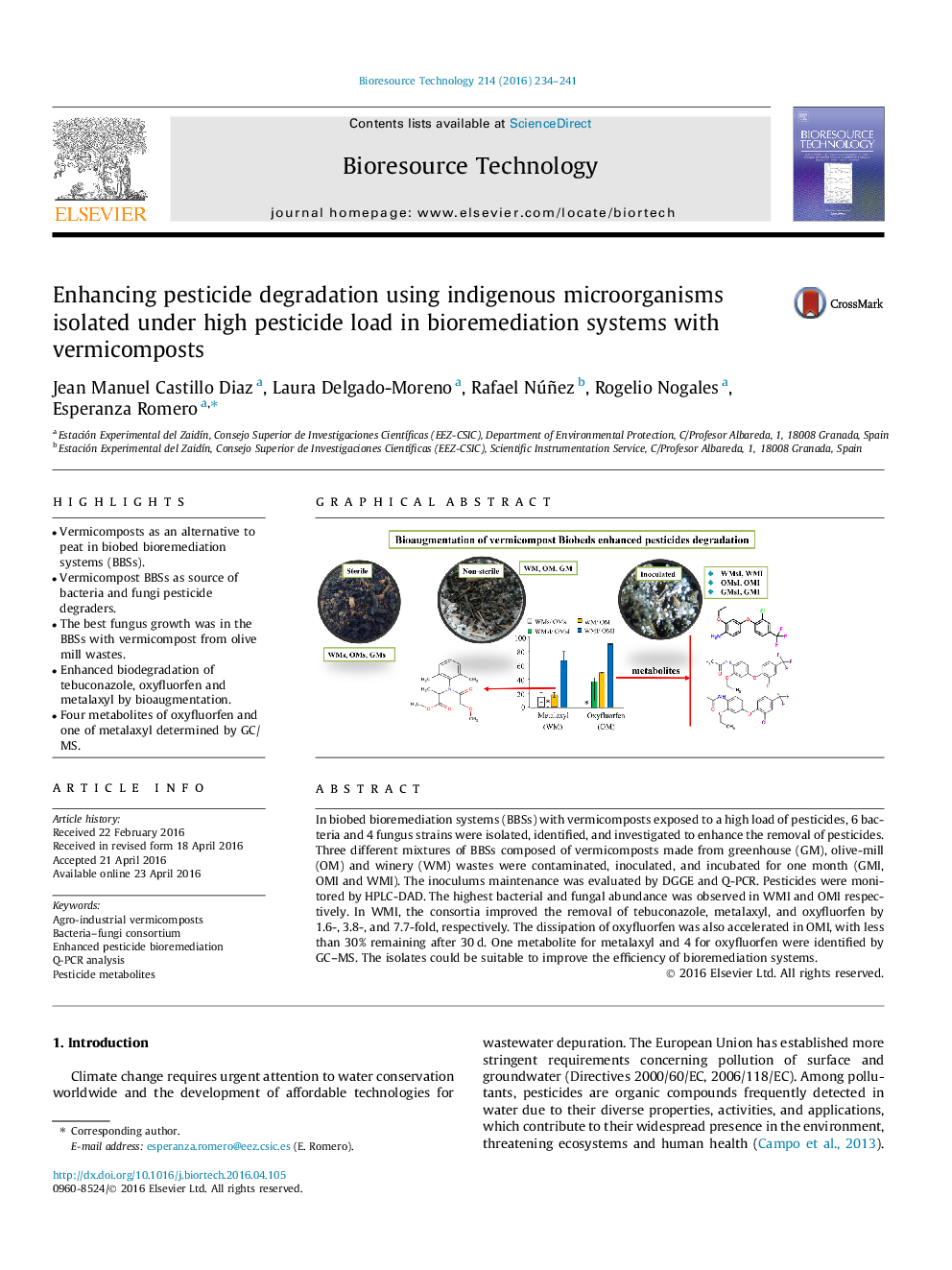
• Vermicomposts as an alternative to peat in biobed bioremediation systems (BBSs).
• Vermicompost BBSs as source of bacteria and fungi pesticide degraders.
• The best fungus growth was in the BBSs with vermicompost from olive mill wastes.
• Enhanced biodegradation of tebuconazole, oxyfluorfen and metalaxyl by bioaugmentation.
• Four metabolites of oxyfluorfen and one of metalaxyl determined by GC/MS.
In biobed bioremediation systems (BBSs) with vermicomposts exposed to a high load of pesticides, 6 bacteria and 4 fungus strains were isolated, identified, and investigated to enhance the removal of pesticides. Three different mixtures of BBSs composed of vermicomposts made from greenhouse (GM), olive-mill (OM) and winery (WM) wastes were contaminated, inoculated, and incubated for one month (GMI, OMI and WMI). The inoculums maintenance was evaluated by DGGE and Q-PCR. Pesticides were monitored by HPLC-DAD. The highest bacterial and fungal abundance was observed in WMI and OMI respectively. In WMI, the consortia improved the removal of tebuconazole, metalaxyl, and oxyfluorfen by 1.6-, 3.8-, and 7.7-fold, respectively. The dissipation of oxyfluorfen was also accelerated in OMI, with less than 30% remaining after 30 d. One metabolite for metalaxyl and 4 for oxyfluorfen were identified by GC–MS. The isolates could be suitable to improve the efficiency of bioremediation systems.
Figure optionsDownload as PowerPoint slide
Journal: Bioresource Technology - Volume 214, August 2016, Pages 234–241