| کد مقاله | کد نشریه | سال انتشار | مقاله انگلیسی | نسخه تمام متن |
|---|---|---|---|---|
| 5162328 | 1502294 | 2014 | 6 صفحه PDF | دانلود رایگان |
عنوان انگلیسی مقاله ISI
Experimental formation of geomacromolecules from microbial lipids
دانلود مقاله + سفارش ترجمه
دانلود مقاله ISI انگلیسی
رایگان برای ایرانیان
موضوعات مرتبط
مهندسی و علوم پایه
شیمی
شیمی آلی
پیش نمایش صفحه اول مقاله
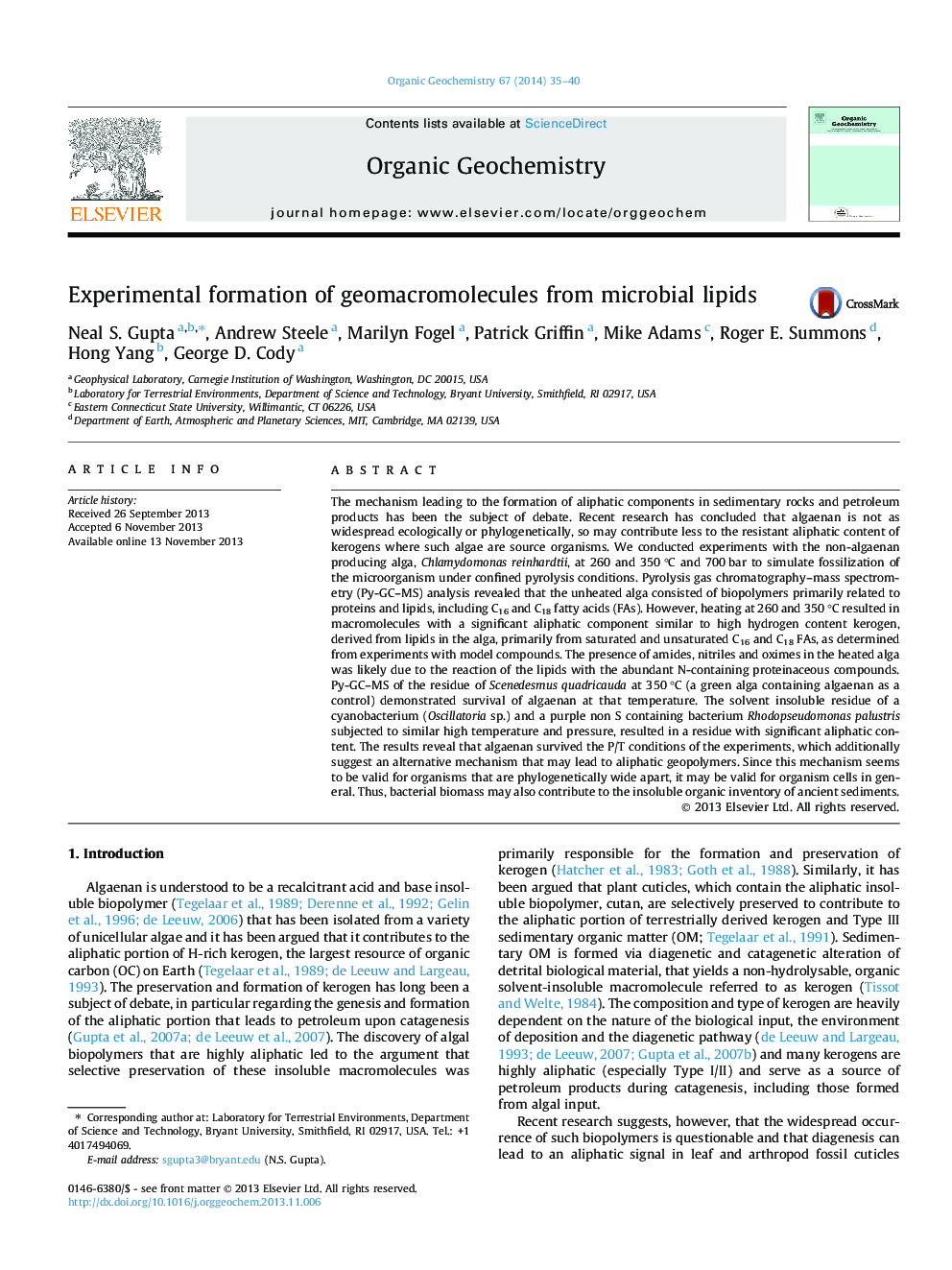
چکیده انگلیسی
The mechanism leading to the formation of aliphatic components in sedimentary rocks and petroleum products has been the subject of debate. Recent research has concluded that algaenan is not as widespread ecologically or phylogenetically, so may contribute less to the resistant aliphatic content of kerogens where such algae are source organisms. We conducted experiments with the non-algaenan producing alga, Chlamydomonas reinhardtii, at 260 and 350 °C and 700 bar to simulate fossilization of the microorganism under confined pyrolysis conditions. Pyrolysis gas chromatography-mass spectrometry (Py-GC-MS) analysis revealed that the unheated alga consisted of biopolymers primarily related to proteins and lipids, including C16 and C18 fatty acids (FAs). However, heating at 260 and 350 °C resulted in macromolecules with a significant aliphatic component similar to high hydrogen content kerogen, derived from lipids in the alga, primarily from saturated and unsaturated C16 and C18 FAs, as determined from experiments with model compounds. The presence of amides, nitriles and oximes in the heated alga was likely due to the reaction of the lipids with the abundant N-containing proteinaceous compounds. Py-GC-MS of the residue of Scenedesmus quadricauda at 350 °C (a green alga containing algaenan as a control) demonstrated survival of algaenan at that temperature. The solvent insoluble residue of a cyanobacterium (Oscillatoria sp.) and a purple non S containing bacterium Rhodopseudomonas palustris subjected to similar high temperature and pressure, resulted in a residue with significant aliphatic content. The results reveal that algaenan survived the P/T conditions of the experiments, which additionally suggest an alternative mechanism that may lead to aliphatic geopolymers. Since this mechanism seems to be valid for organisms that are phylogenetically wide apart, it may be valid for organism cells in general. Thus, bacterial biomass may also contribute to the insoluble organic inventory of ancient sediments.
ناشر
Database: Elsevier - ScienceDirect (ساینس دایرکت)
Journal: Organic Geochemistry - Volume 67, February 2014, Pages 35-40
Journal: Organic Geochemistry - Volume 67, February 2014, Pages 35-40
نویسندگان
Neal S. Gupta, Andrew Steele, Marilyn Fogel, Patrick Griffin, Mike Adams, Roger E. Summons, Hong Yang, George D. Cody,